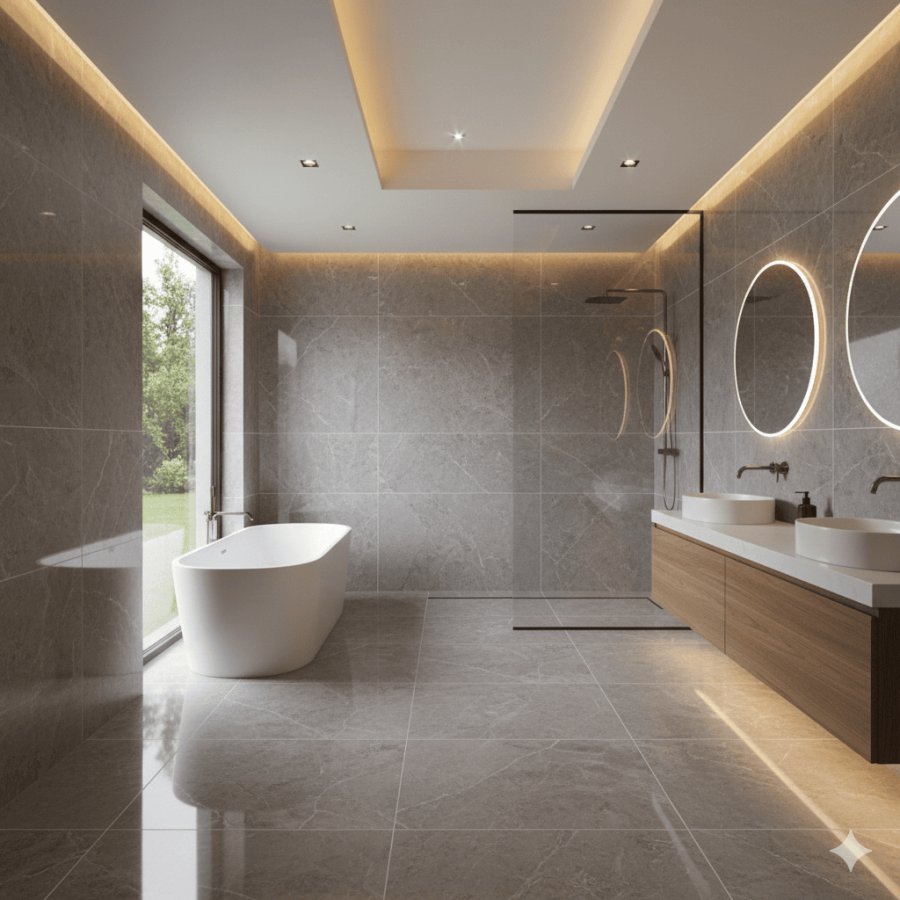
Ceramic Floor Applications
Aesthetics, Durability, and Hygiene: A Comprehensive Guide to Ceramic Floor Tile Applications
Introduction: Why Are Ceramic Floor Coverings So Important?
Ceramics are one of the most fundamental materials in the construction sector, used for thousands of years and reshaped today by modern technology. Ceramic floor tile applications are widely preferred in a broad spectrum, from residential to commercial areas, and from wet rooms to high-traffic public squares. Ceramic is a durable surfacing material made from natural materials like clay, kaolin, quartz, and feldspar, fired at high temperatures.
Ceramic tiles, and the more durable type known as porcelain tiles, not only enhance the visual quality of a space but also stand out for their long-term functionality, water resistance, and ease of cleaning.
Key Advantages of Ceramic Flooring:
Water and Moisture Resistance: Especially glazed and porcelain tiles are ideal for bathrooms, kitchens, and exterior areas due to their low water absorption rate.
High Abrasion and Impact Resistance: They are highly resistant to heavy foot traffic and commercial use. Abrasion resistance can be easily determined by the PEI rating.
Easy Cleaning and Hygiene: Their surfaces repel dirt, are stain-resistant, and easy to clean, which is critical, especially for healthcare facilities.
Design Versatility: They offer limitless color and texture options, including wood-look, marble-look, concrete-look, geometric patterns, and large-format slabs.
Fire Safety: Since they are made from non-combustible materials, they contribute to fire safety.
Types of Ceramics and Technical Specifications: Making the Right Choice
Choosing the correct type of ceramic tile based on the area of application and the load it will bear is crucial for the lifespan of the installation.
1. Types of Ceramic Tiles
Faience (Wall Tile): Has a higher water absorption rate. Generally used indoors and only for wall cladding. It has low durability.
Floor Tile: A type of ceramic with lower water absorption and higher strength compared to faience.
Porcelain Tile (Porcelain Stoneware): Ceramics fired at very high temperatures, with a water absorption rate below 0.5%. This makes them resistant to frost, gives them high abrasion resistance, and allows them to be safely used on interior and exterior floors.
2. Critical Technical Parameters
| Technical Parameter | Definition | Importance and Ideal Value |
| Water Absorption Rate | The percentage of water the tile can absorb by weight. | Should be below 0.5% (Porcelain) for exterior and wet areas. |
| PEI Rating | The surface's resistance to abrasion (from class 1 to 5). | PEI 4 or 5 should be preferred for heavy commercial traffic. |
| Slip Resistance (R Value) | The degree of slipperiness of the tile's surface (from R9 to R13). | R9-R10 for interiors; R11 or R12 for exteriors, pool surrounds, and wet areas. |
Ceramic Floor Tile Application Stages: Step-by-Step Quality Workmanship
A professional ceramic floor tile application involves meticulously following steps to create a floor that is not only aesthetic but also robust and waterproof.
1. Substrate Preparation and Waterproofing
Floor Screed Preparation: Tiles must be applied onto a level, solid, and uniformly poured floor screed. While the screed's moisture content is not critical for the tile adhesive's performance, the screed's load-bearing capacity is important.
Waterproofing (Wet Areas): In areas that will come into contact with water, such as bathrooms, balconies, and terraces, a cement-based liquid waterproofing (isolation) material must be applied before tiling. This completely prevents water from seeping into the sub-layers.
Primer Application: Primer should be used to increase adhesion, especially on highly absorbent old screeds or plasterboard surfaces.
2. Selection and Preparation of Tile Adhesive
Adhesive Selection: Adhesive is chosen based on the type of tile and substrate:
C1 (Standard): For standard interior floor tiles.
C2 (High Performance): Essential for porcelain tiles, large-format slabs, exteriors, and underfloor heating systems.
S1/S2 (Flexible): Flexible S1 or S2 class adhesives should be preferred for high-risk, moving substrates or underfloor heating systems, as they add flexibility to handle deformation.
Preparation: The adhesive is mixed with the specified amount of water according to the manufacturer's instructions, using a mixer until it reaches a homogeneous consistency.
3. Laying and Joint Spacing
Level Determination: The floor level and slope are determined with a laser level (slope toward the drain is critical in bathrooms).
Troweling: The adhesive is spread onto the floor with a notched trowel. Trowel notch depth (8 mm, 10 mm, 12 mm) is selected based on the tile size.
Back Buttering Technique (Butter and Floating): For tiles larger than 60x60 cm, applying adhesive to both the substrate and the back of the tile (back buttering) is mandatory. This prevents air voids beneath the tile and ensures 100% adhesion.
Joint Gap: Minimum 2 mm (interior), 3–5 mm (exterior or large format) tile spacers are used to leave joint gaps between the tiles. Leaving joints is vital for accommodating expansion and contraction movements.
4. Grouting and Cleaning
Grouting Material: After the tiles cure (usually after 24 hours), the joint gaps are filled with cement-based or, for greater durability and water resistance, epoxy-based grout.
Flexible Joints: Flexible materials like silicone or polyurethane sealant should be used instead of cement-based grout in movement areas such as wall-to-floor junctions, corners, and expansion joints.
Cleaning: Excess grout on the surface is cleaned with a damp sponge and plenty of water shortly after the grout application.